How to reverse into a parking space
Reversing in feels backwards, but it is actually easier than driving in nose-first: the steering wheels are at the front, so the car pivots into the bay. And you drive out forwards, seeing everything.
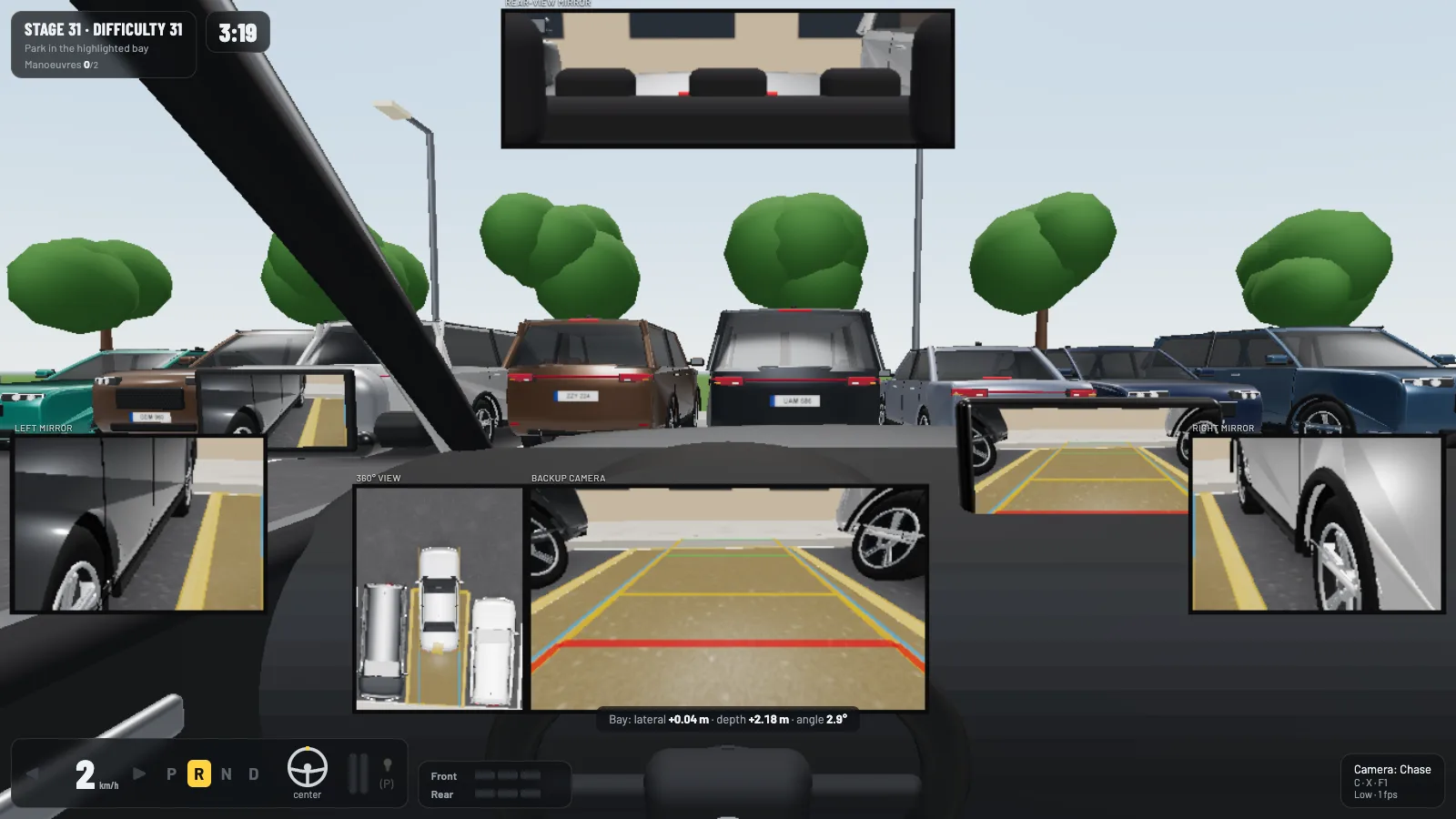
Why reverse in?
Leaving is the risky part of parking: pedestrians and traffic. Reversing in means you leave nose-first with a clear view. It also fits tighter bays, because the rear of the car turns in a smaller circle.
The method
Pass the bay
Drive along the aisle about 1.5 m from the parked cars. Pass the space until your rear bumper is about one bay beyond it.
Stop and select reverse
Stop completely. Check mirrors and blind spots. Signal towards the bay.
Full lock
Reverse slowly and turn the wheel fully towards the bay. Watch the mirror on the bay side: the car next to the space should slide past with room to spare.
Watch both lines
As the car rotates, the bay lines appear in both mirrors. Keep the gap to each line equal.
Straighten
When the car is parallel to the lines, straighten the wheel and reverse straight in.
Stop at the end
Stop when the rear is near the back of the bay — the backup camera’s red line or the parking sensors help — and leave the wheel straight.
Practise it in the Reversing chapter, first in an open car park and then between pillars underground.
Practise nowCommon mistakes
- Not passing the bay far enough: the car comes in at an angle and touches the neighbour.
- Watching only the camera: the front corner swings out. Glance at the front too.
- Straightening too late: the car ends up crooked. Straighten as soon as it is parallel.